Showing posts with label teen. Show all posts

4.27.2015

Tools for IEP, High School Transition, and Future Planning Jitters

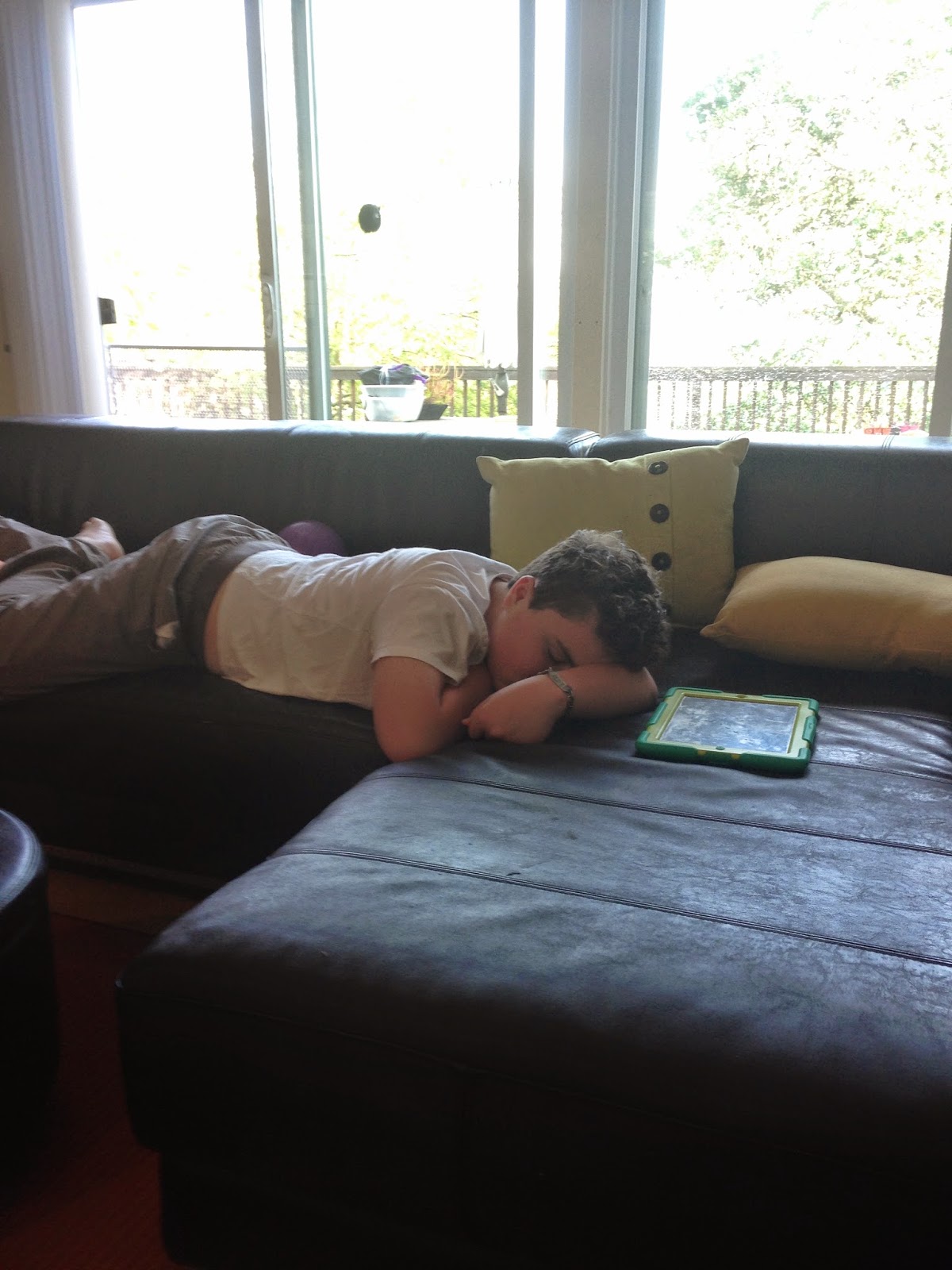
Teens. They can nap. Who knew?
[image: teen with short curly brown hair
and beige skin sleeping face-down
on a brown leather couch, in front of a
bank of windows filled with daylight.]
Leo has a mustache. It's not shave-worthy, not yet -- but it's a mustache all the same. Which means my newly-deep-voiced son is officially a teen, and my lingering denial about him exiting boyhood needs to evaporate. Which means I really have to get serious about planning for his future as a teen, and also as an adult. Not just his personal life, but his school and post-school futures. It's daunting, and I'm anxious.

Thankfully, I'm lucky, we're lucky, Leo is lucky in so many ways. Leo goes to a great school, filled with supportive and understanding staff. The people at Leo's current school district make it possible for him to be at his wonderful school even though it's 20 miles outside the boundaries of that district. I know where to find online tools to help make sense of complicated special education and disability services and planning issues. And, if, heaven forfend, I needed a special education advocate, I know one of the best.

But I'm still nervous, because there are still unknowns and scary processes ahead. So bear with me as I go over the resources and approaches that have made it possible for Leo to be in such a good position now, and will hopefully make his future a bright one. Any additional advice is welcome.

----

Leo just had his triennial IEP,  or his every-three-years full evaluation to adjust his official disability categories, if needed. Even though the process was a straightforward and friendly one, the entire team worked closely to ensure Leo's IEP documentation and goals were crystal-clear. While we might all know what his goals are, and how they should be approached, what if we moved to a new school district? The IEP would move with us, and the new district would need to be able to make sense of Leo's goals. Knowing how to create a useful IEP is a critical skill for parents in my position, so if I did need IEP support, or if I anticipated problems, I'd make the most of online resources like Wrightslaw, or the IEP Wizard from the NEA (National Education Association) Teacher Toolkit.

We were also careful about the goals themselves, about ensuring that they are meaningful (here are some guidelines for writing good goals). For example: I'm interested in Leo getting to learn vocational skills, but I don't want sorting beads to be an IEP goal because our dude would get bored, and fast. I think Leo would like to work on typing specific words, but words that are useful to him, words that are part of his curriculum and life, and not random spelling list words. And so on.

As for his actual placement: He's going to stay in the same classroom, with the same amazing teacher and staff. I firmly believe an inclusive educational environment would be ideal for Leo, but that option is not currently available in our area. (To be clear: By 'inclusion' I mean an educational environment where Leo would be part of classes in which he could participate, given the proper support, on a regular school campus. I do not mean forcible mainstreaming with no supports.) If inclusion was available, I'd be looking to the site Think Inclusive for advice and strategies to ensure Leo was included properly and not just superficially, or (eep) problematically. Though his school does do reverse inclusion, and I have been assured by Leo's teacher that it is a peer-to-peer rather than an "assigned friends" scenario. I would not be pleased if my son was being treated as a project rather than a person.

We also confirmed that Leo will be (finally) getting a symbol-to-speech AAC (augmentative and alternative communication) device in the next few weeks, to supplement his limited spoken language. His SLP and the schools' AAC specialist were careful to emphasize that Leo will be essentially learning a new language, and that it would be easier for him if we could provide an immersive environment, i.e., if we used AAC with him as well. As our insurance will not cover two devices, I've downloaded a complementary iPad AAC app, and will be learning to use it. I am certain I'll be making much use of the strategies and advice at the excellent site PrAACtical AAC.

Another issue was his transition to high school. He will be in ninth grade next year, and that means the elementary school district will stop funding  his education and services, and the high school district will take over. There was no guarantee that Leo would stay at his current school, but thankfully the high school district realized that Leo was in a good place and they could not provide an equally beneficial and enriching environment themselves. However, if there had been problems I would have been frantically consulting the IEP tools and resources at WrightsLaw. And possibly calling my friend, professional special education advocate Carol Greenburg.

Leo will get to stay at his school until the age of 22. But then he needs to have a job, or at least some  place to spend his days so he's not stuck at home with his boring mother. While the NEA provides plenty of practical advice and strategies for becoming a self-advocate, cultivating useful job skills, and supporting young adults through their transition out of school, the actual real-world local opportunities for Leo and people like him are frustratingly elusive, and (again) any advice would be appreciated. (My denial in this area also need to come to an abrupt end. I know, I know.)

And finally, Leo also needs a plan for a future without me, and without his dad. There's no reason, currently, to believe Leo won't outlive us, so it's on us to make sure Leo will have all his needs taken care of, and will also have trustworthy people in his life to help him make the right decisions -- or the right decisions for him, if need be. We have investigated our options and taken the necessary steps to establish resources for our beloved son, and I hope you have explored the options for your family as well -- especially since the recent passage of the ABLE Act, which will allow people with disabilities to save money more easily and with fewer penalties than are currently possible, will hopefully make that planning much easier.

----

How have your recent IEPs, transition meetings, post-school experiences, and future planning gone so far? Feel free to share your experiences in the comments.

----

Disclosure: this post was sponsored by NEA, the National Education Association, which provides extensive online special education resources.

5.09.2012

Expectations Adjustment: Professional Hair Styling for 8th Grade Graduation

Iz, as you may be shocked to learn if you've been reading this blog since I was dithering over whether to put her in kindergarten or first grade, will be going to high school in the fall. HIGH SCHOOL. Which means avalanches of shock and denial on my part. What the hell, people? She is almost as tall as me, definitely more athletic and academic than I ever was, and -- based on superficial factors -- certainly more likely to leave a trail of broken hearts in her wake. If she wasn't so damn cheeky I'd be mired in appreciative rather than irritated disbelief at the marvelous being Seymour and I spawned.

But before she hits the big grades, she'll be graduating from eighth grade. Next month. There will be a ceremony. Which is apparently a much bigger deal than it was when I hurriedly tossed on my lone Jessica McClintock frock and sat blinking in the Anaheim sun, alternately taking Disc camera photos of my friends, and family -- including my brother Chet, who had just finished his first year at the USMA, looked very handsome in his uniform, and made all the girls squee. It was fun, but it was not a source of stress.

Things are different for Iz's peers, apparently. As Iz informed me yesterday, "all the girls" now get their hair professionally did for 8th grade grad. To which my reply was a parent-censored version of WTF. Really? Professional styling for thirteen year olds?

I don't have a problem with girls of any age occasionally getting their hair or nails done at a salon, as a treat. I do have a problem with kids expecting those services as their right, especially with entitled attitudes that include declaring, as Iz did, that it shouldn't be a big deal because it's "only 35 dollars." As if she had 35 dollars lying around. And not as if she asked what she could do to earn said $35 (though she did, later, after the top of my head blew off and she realized she needed to rethink her strategy). As if we hadn't had a conversation just the month before -- after one of her cousins offhandedly described a non-essential cost as being "only $50" and I almost fell over -- about the difference between understanding a good deal, and not understanding the value of goods and services or of currency itself.

It's not as though she doesn't know how to do her own hair -- she spends hours each day straightening and molding and manipulating her tresses, with mostly impressive results. And it's not as though she doesn't have a mother and friends and auntie-friends like Jennyalice and grandmothers who have Hair Skillz at her disposal. But for some reason, she seems to think her hair won't be "right" unless it's done the way her friends are getting it done.

I suppose I'm mostly dismayed with what I see as a continuous cultural shift away from self-reliance and towards dependence on professional services when it comes to self-care. But maybe this is just the way her generation will be? Maybe it's a California thing? Maybe a cultural thing?

She'll look great either way. But does a 13 year old girl really need professional hair styling? My gut tells me no. But I'm not living her life, I'm revisiting mine -- as someone who loved figuring out how to create Audrey Hepburn updos, What's New Pussycat straight red sheets, and Veronica Lake peekaboos all on my own. Am I expecting too much? Is this just what kids do these days?

4.30.2012

UU Sex Ed FTW

Iz is just finishing up her OWL (Our Whole Lives) sex ed class at our Unitarian church. She's been going for three hours every Sunday evening for several months. They've covered a wide range of topics, from dating to gender identity to STDs to reproduction to sexual identity (including a PFLAG presentation), and plenty of frank, frank talk. 
I very much wish I'd had access to this kind of clear, non-judgmental information sharing when I was thirteen, and then spent time in an open and accepting Q&A arena. Wasn't going to happen in a Catholic RE class in 1983, no sir. But how many of us could have benefited from last week's exercise & discussion, I wonder? From the charming Derby, our UUFRC Director of Religious Education:
Tonight was all about sexually transmitted infections (STIs).  We started with a condom obstacle course, which is designed to counter myths about condom use.  The teens try condoms on their hands and see what they can feel through the condom (e.g., a feather) to counter the "I can't feel anything" myth.  They stretch and measure (and in some cases, blow up like balloons) condoms to counter the "I'm too big" myth.  Using wooden penis models, they practice putting on a condom correctly and see how quickly they can do so to counter the "it's too complicated" and "it will take too long" myths.  This is widely regarded as the most popular activity of the entire OWL class.
 
We followed the obstacle course with an activity that demonstrated transmission of STIs by exchanging M&Ms with various partners (different colors representing different STIs or no consequence).  Next was a summary of several STIs (symptoms, permanent harm caused, cure, vaccine, transmission, and prevalence in the U.S. population).  We followed that with a myth or fact game.  Last, we had an activity in which the youth were asked to give advice to teens who had had sexual intercourse and were going to date someone new.
IKR?

One of the joys of last weekend was witnessing my godson's First Communion at a local Catholic church. I hadn't been face-to-face with a crucifix since my dad's funeral almost exactly five years ago, I realized. And while I still respect Jesus and his messages mightily, and found the routine of the Mass comforting, I have no regrets about my chosen UU spirituality -- especially regarding its guidelines and supports for our children.