8.03.2015

It's Blogust! Time to Give Kids a Shot@Life!

It's Blogust! That time of year, that annual August period when life-saving advocacy couldn't be easier for good people like you to take part in. When Shot@Life donates a life-saving vaccine to a child in need every time you share the #Blogust tag on public social media (Instagram, Pinterest, Facebook, Twitter).

The tl;dr version?

One #Blogust Comment, One #Blogust Share or One #Blogust Like = One Vaccine 

The just-the-facts version:

  • Humanitarian: A child dies every 20 seconds because they don't have access to life-saving vaccines, and 1 in 5 children lacks access to vaccines. Plus, immunizations save the lives of 2.5 million children, each year.
  • Public Safety: Measles infects 95% of the unvaccinated people who encounter a carrier; polio is only a plane ride away from returning to the United States. And babies can't be vaccinated in against measles in their first year of life. To keep ourselves safe, we must help eradicate vaccine-preventable disease in the rest of the world.
  • Cost-savings: The costs of eradicating smallpox are more than recouped by an annual savings of the one billion dollars that would have been needed for treatment, etc. And we're so close to eliminating polio! The current goal for a polio-free world is 2018, and it's reachable.
The How You Can Help Right Now version:
To kick off #Blogust, the @ShotAtLife team will be hosting a Twitter party on August 3 from 1-2 p.m. ET. We would love to see you there - every tweet with #Blogust or @ShotAtLife during this hour equals one vaccine for a child around the world
And since the subject of autism still (still!) comes up sometimes when we're trying to save lives with vaccines, I've compiled a Pinterest page on Busting Autism-Vaccine Myths. Please feel free to use it as a resource, or let me know about any resources I'm missing.

8.02.2015

At SF City Hall the Day the UN Turned 70, SCOTUS Formalized Marriage Equality, and Malala Spoke

June 26th was a day to be at San Francisco City hall. I was invited to attend the UN70 ceremony to celebrate the 70th anniversary of the signing of the United Nations Charter as part of the Bay Area Digital Leaders initiative, which was thrilling enough -- I knew we'd get to see UN Secretary General Ban-Ki Moon, House Minority Leader Nancy Pelosi, and SF's own Mayor Ed Lee speak. I was honored to witness such recounting of history, listen to such people, and be present during such a milestone.

And then, the morning of the ceremony, SCOTUS ruled that marriage equality was the new law of our land. Much happy hollering happened at our house, I can assure you. Though I arrived at City Hall after the morning's celebratory rally, I still got to see many jubilant people getting married (or celebrating the ability to get married) without worrying that their marriage might be delegitimized by my fine state -- or any other in our more perfect union.

And then, during the gorgeous UN70 ceremony, Malala Yousafzai made a surprise appearance. It turned out she was actually sitting right next to me, just around a pillar on the balcony overlooking the ceremony. And then Malala came and gave a surprise talk to our Bay Area Digital Leaders crew afterward. I was ten feet away from Malala, twice in one day. I nearly swooned, both times.

As you may imagine if you know me, processing such events took a while, which is why I'm only writing about it now. For full details about UN70, I recommend the official UN70 site. But if you want to see my pictures -- and to see my video and read my transcription of Malala's talk, keep scrolling.

(So much wow.)

The UN70 Ceremony
[image: Atrium of San Francisco City Hall, seen from the second floor balcony,
with floor and balconies full of people of all ages, races, and genders.
An iron-railed staircase is lined with flags of different nations and a boys choir,
and leads to a large light blue draped rectangle featuring the white UN logo.]
The UN70 ceremony featured a number of surprise guests, such as our very own Governor, Jerry Brown, who reminisced about being a child in the audience when the UN Charter was first signed. Former San Francisco Mayor Willie Brown and UN Foundation founder and chairman Ted Turner were also sitting in the front row.

Governor Jerry Brown addressing the crowd
[image: balding white man wearing a suit,
speaking into a microphone at a podium,
to a large audience, next to a collection
of international flags.]
UN Secretary-General Ban-Ki Moon was charming and inspiring, in delivering his message of the importance of the 70th anniversary of the United Nations:
"Every day, the United Nations makes a positive difference for millions of people: vaccinating children; distributing food aid; sheltering refugees; deploying peacekeepers; protecting the environment; seeking the peaceful resolution of disputes and supporting democratic elections, gender equality, human rights and the rule of law."
UN Secretary-General Ban-Ki Moon
[image: Korean man with short black hair
and glasses wearing a dark suit,
speaking into a microphone at a podium,
next to a collectionof international flags.]
And then, the Secretary-General gestured up to near where I was sitting, and said something about welcoming a Very Special Guest. The crowd started roaring. I couldn't hear exactly what he was saying due to the din, so peeked around the pillar to my left -- and this is who I saw:

Malala Yousafzai and entourage
[image: teen Pakistani girl wearing a
colorful headscarf and outfit, seen in profile,
seated at a balcony amidst a row of other people.]
Yes, that is Malala Yousafzai, 2014 recipient of the Nobel Peace Prize. Reader, I nearly fainted.

And if that wasn't enough of an honor, Malala joined UN and UN Foundation officials Cristina Gallach, Maher Nasser, and Aaron Sherinian, in addressing we fortunate attendees of the Bay Area Digital Leaders reception. 

Mr. Nasser, who is Palestinian, spoke to us about how one of the reasons he supports and works for the UN is because he spent part of his childhood as a refugee, and was educated in UN Schools. And Malala spoke about the importance of not waiting for anyone but you to start making a change in the world, as well as on behalf of global human rights and personal responsibility. She also echoed some of the statements I recently made about iPads and like tech, in terms of understanding that such advances are not available to all students, and that life-changing tech needs to adapt and be beneficial under low tech circumstances. My video and transcription of Malala's talk is below.

I hope she will leave you as inspired as she and the entire UN70 day left me.

Cristina Gallach, Maher Nasser, Malala Yousafzai, and Aaron Sherinian
[image and video description: A teen Pakistani girl, wearing a colorful hijab,
talking into a microphone, to a crowd of people recording her with
smart phones. She is accompanied by a Spanish woman with
chin-length brown hair; a Palestinian man with close-shaven dark hair,
and a tall white American man with short black hair]


TRANSCRIPT

AARON SHERINIAN:

We ask for some words from you.

MALALA YOUSAFZAI:

Thank you so much all of you, it’s a great opportunity to be here and meet the young generation with wonderful ideas about how to use technology in this mission of raising voices and speaking up for education, and equality, and human rights. And I think it is important that you are all here, and trying to help, and trying to discover how you can use technology in this process.

Because sometimes people ask me, “Why don’t you speak up for that country, why don’t you raise your voice for this issue.” And the message that I always give is:

You have to do it.

Do not wait for someone else to come and speak for you. It’s you who can change the world.

Nor was Martin Luther King Jr. waiting for someone else to speak against racism and discrimination in society, nor was Nelson Mandela waiting. They did it themselves.  And now we need to believe in ourselves; we need to believe in the power we have — the power of voice. And we need to stand up for our rights, and say that we can bring change in the world.

Unfortunately, there are many truths in the world such as people are being discriminated, women are not being given full rights in many countries, and they are not being given the opportunities to do what many can do. So it’s time we speak up for them, we hear their voices, and we help girls to go to school. And this has been the one thing we have been trying to do — it is my mission to see every child going to school. But for now I am focusing on secondary education, because I believe that secondary education is so important. Our world leaders, they only think about primary education.

[few seconds missing, your inept operator accidentally hit ‘stop’ on the camera.]

We have bigger dreams we can achieve — our achievements can be bigger. And that’s why we’ve set our development goals. We have done our best and are still continuing to try to make sure that families get quality education, and free and compulsory secondary education should be included in that, so that both girls and boys do not get deprived of this opportunity, and the chance to go to college, and to discover their full potential.

So we are hoping that you will support us in this campaign, and technology — again — can play a part in all of it. We all together, joining this movement, can bring change, and you can bring great inspiration, to the whole world. And you might believe it or not, but there are children in the poor countries who are waiting and hoping that someone will help them one day — and that is you, and that is one of us who are studying here, who is going to do something.

It’s the modern age. It’s the Twenty-First Century. But unfortunately there are still those living as though before the 19th century. So it’s important that technology is introduced there. And you might think, “well, how could I help a child there with an iPad or a phone or something like that — but we need to think: does the child know anything about an iPad? Has the child *seen* this technology? So before thinking of technology and how it can be important for education, we need to make sure that children in developing countries know about it, and how it can be powerful in helping them with education, and raising awareness, and spreading the message about equality and human rights.

So I’m hopeful that you will have wonderful ideas, and I support you all, and thank you once again.

—-

AARON SHERINIAN: 

Is there a message that a girl somewhere should hear from you on this day in San Francisco?

MALALA YOUSAFZAI:

A girl in a developing country — or a developed country — should be really proud, and should be really hopeful that there are these people thinking about their future, and trying to help them. Because when it comes to women’s rights, it does not depend on which country you live — there is discrimination in almost every country.

So to that girl, to give them hope, she should know that there’s going to be a campaign for her equality, for her education, for her rights, and she should not lose hope that she’ll be discriminated against in society. Because we are here to study with her and allow her to raise her voice, and have this right to a quality education.

8.01.2015

Things You Should Eat: Nutella on Tortilla Chips

For a very long time -- about twenty years -- I firmly believed a Digestive biscuit with a swipe of Nutella was one of the best things a person could ever hope to eat.

With good reason: back when I lived in Ghana as a college exchange student and factory-made sweets weren't always easy to find, we could usually get Digestive biscuits (and Walker's shortbread, another Achilles heel of mine) from street vendors. While the biscuits were a treat on their own, what my fellow exchange students and I truly lusted was Nutella to put on them. We weren't able to find Nutella easily in 1990, nor was it a reasonable purchase (about $20/jar at specialty import stores, if I recall correctly). But we would occasionally pool our funds, buy a single jar, and huddle in a pack, eating our Digestives with this ambrosia on top.

(Of course once I returned home to the U.S., I lusted after no-longer-available Ghanaian specialties, like kelewele and fufu and kenkey. I should have appreciated them more at the time. And I craved them -- and the company of my Ghanaian friends -- so much I've been back to Ghana twice. But I digress.)
[image: round sweet Digestive biscuit with a swipe of
dark brown chocolate Nutella.]

My current ability to have Nutella around whenever I like has never ceased to delight me. (My family shares this sentiment, thought not for the same reasons.) Nutella on hand also pleases most visiting children.

And sometimes those kids surprise me. Like when when of Mali's friends insisted I try Nutella on tortilla chips. In hindsight, the scrumptiousness of the combination shouldn't have surprised me -- my favorite chocolate bar has cornflakes in it, after all. And it helps that we generally have good, thick chips on hand -- I won't have Doritos or Tostitos or bulk Costco crap in THIS house. (If you have access to good corn tortillas, you can even make your own chips.)


[image: triangular yellow-brown tortilla chip
with a swipe of dark brown Nutella.]
With those good tortilla chips, this combination is pure deliciousness. Even better than Nutella on Digestives, a phrase I previously considered inconceivable. Trust me. Try it. Then come back and tell me what you think.

7.20.2015

Let's Get Away From It All: Local Beach Version

Things have been a bit stress bombish than usual over here lately. Shocker, for a house with two teens and one tween, I know. So I was even more grateful than grateful when Leo and I found ourselves by ourselves a few days ago, with a free afternoon to boot.

We bolted for the Coast, as we do every chance we get. And we went to our favorite beach. And we lolled in the sun-warmed pebbles at our favorite beach. (By "we" I do not mean only Leo. I mean I took the photo below as I was also lolling, alongside Leo.)

[image: white teen boy with curly brown hair lying on
his side on a pebbled beach, seen from the top of his head,
with the ocean, clouds, and blue sky in the background.]
And we ran our hands through the beautiful warm pebbles, marveling at how they felt when they slipped through our fingers, or changed temperature to a surprising coolness a few inches below the surface.

[image: close up of a pinkish thumb and forefinger,
and lots of multi-colored pebbles.]
We stayed until Leo felt it was time to go, as we had nowhere else to be. Nowhere else to be! Such a luxury, for we two typically overscheduled reprentatives of our almost always overscheduled family of five.

[image: White teen boy wearing a blue t-shirt and
beige shorts, seen from behind, walking along a beach
lined by small bluffs.]

Since you weren't there, I got you a souvenir. Here is a sixty-second video of the ocean being lovely and soothing for us. Pull this out of your pocket whenever you need a virtual seashore visit.

[video description: sixty seconds of ocean waves rolling on
and off the beach at a small cove surrounded by bluffs & rocks.]

6.26.2015

Today: The 70th anniversary of the signing of the United Nations Charter

[Image: Dark blue square with an image of the UN headquarters
in the background, white text superimposed, reading:
"United Nations: 70 Years Promoting Peace and Progress
 #UN70" followed by the United Nations Foundation logo]
I am thrilled, delighted, and honored to be on my way to City Hall in San Francisco right now, to celebrate the 70th anniversary of the signing of the United Nations Charter, along with UN Secretary General Ban-Ki Moon, House Minority Leader Nancy Pelosi, and SF's own Mayor Ed Lee.

And I am more than a little bit bowled over to be one of 70 invited Bay Area Digital Leaders. You can witness my being wowed, as well as my coverage of the ceremony, in real time on Twitter @shannonrosa, if you like. And you can follow coverage at #UN70 and #UNdiscovered. See you on the other side.

More information about why the UN matters, this amazing event, and what we're celebrating and commemorating today: 

"On June 26, 1945, representatives of 50 nations gathered in San Francisco and signed the United Nations Charter. From that moment on, the Bay Area has played a critical role in advancing the mission and values of the United Nations. As the UN confronts today’s challenges and seizes tomorrow’s opportunities, each of us can play a role in supporting its work."


See 70 years of UN highlights in photos!
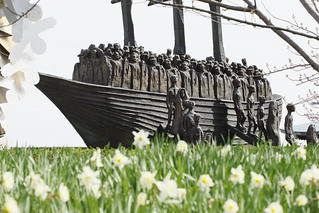
Spring Returns to UN Headquarters in New York
[image: Daffodils in bloom surround the sculpture
“Arrival” by John Behan.]

6.25.2015

Haircuts Both Miraculous and Useful

This is for posterity. Two haircut milestones.

First: Witness what Leo's level of comfort and familiarity with our local hair salon and local stylists means: He, his sister Mali, and I all got our hair cut together. At the same time. When Leo was done his stylist handed him his iPad, and suggested he go sit in a chair and wait for me. Which ... Leo did. Patiently. Like the mature teen dude he is.
[image: hair salon panorama: white tween girl with brown hair getting her hair cut
by an Asian woman with long wavy dark brown hair; Asian woman with
shoulder-length black hair cutting the hair of a white woman with red hair
who is holding a turquoise smart phone in front of her face, and white teen boy with
short dark brown hair getting his hair cut by an Asian man with short black hair.]
And here are the before-and-afters for Mali. I think her new 'do is fetching, but her reasoning for this shortest-ever cut is both practical, and tactical -- she wanted a style that would not catch in her Bo staff during karate practice. A girl's gotta have her priorities.
[image: white tween girl
wearing glasses and a blue
t-shirt that reads "RAWR!!"
in pink letters, with chin-length
dark brown curly hair.]
[image: (same) white tween girl
wearing glasses and a blue
t-shirt that reads "RAWR!!
MEANS I LOVE YOU"
in pink & yellow letters,
with ear-length
dark brown curly hair.]

5.30.2015

Parents New to Autism: Don't Fall for Pseudoscience like DAN! or MAPS.

This is an edited-for-privacy version of an article I posted on an autism parenting board this morning, in response to a parent asking for advice about DAN! doctors.

----

One of the loveliest features of this group is the opportunity for parents who are new to the world of disability and autism is to hear from parents with many years of experience -- so those new parents can avoid some of the mistakes we veterans unwittingly made.

DAN! (or MAPS, or "biomedical" approaches to autism, doesn't really matter) is pseudoscience. That means it is poppycock but sounds "sciencey," so that parents who are given few answers for how to help their autistic child by the mainstream medical establishment, and who are often desperate to "fix" their autistic child because of negative media messages about autism, will grasp at such seemingly authoritative straws. Hence the need for such practitioners to mention Ivy League  credentials, etc., repeatedly.

Note that DAN! doctors don't usually take insurance. So, erm, what are the families who can't afford such treatment supposed to do? Don't you think that if DAN! ideas were truly effective they would be embraced by the mainstream medical establishment and the government so that children of all income backgrounds could benefit, not just those whose families have sufficient income (or houses to mortgage)?

Love my dude.
[Image: Woman with medium-length red hair and sunglasses
sharing an embrace with a boy with short brown hair
Both with beige skin.]
Don't fall for it. Autistic kids need your understanding, not fixing. Yes, they need to learn how to cope with the world. But they also need to you help change the world, make it accommodate them, so they don't become so traumatized by it that they can't learn, or enjoy life.

Here are some guidelines for identifying DAN!/MAPS and other autism pseudoscience:

...all autism approaches should mirror the physicians’ credo “First, do no harm.” But how do you determine when benefits outweigh potential damage? The pseudoscience so often promoted as “autism treatments” has a handful of consistent identifying characteristics. Ask yourself:
  • Does this practitioner or vendor promise miracles that no one else seems to achieve?
  • Is the person promising the outcome also asking me for money?
  • Do I find any scientific research supporting their claims, or are there only individual (often emotional) testimonials of effects?
  • Does the practitioner or vendor promise a blanket “cure” for unrelated disorders, such as grouping together allergies and autism; or autism and ADHD; or autism, diabetes, cancer, and allergies?
  • Does the practitioner or vendor have strong credentials as an expert in the therapies they’re promising, or in the field of autism?
Thinking critically is one of the most important actions we can take for those we love, and for ourselves.

From: http://www.thinkingautismguide.com/p/mission-statement.html
 
Here are some other resources for parents new to autism:
 
Good luck. You are not alone. So don't fall for anyone who tries to isolate you and turn you against the mainstream medical establishment -- while gladly taking your money.

-Shannon

5.22.2015

How Can Tech Benefit Autistic People? My Comments at IMFAR 2015's ASDtech panel

One of the highlights of the 2015 International Meeting for Autism Research (IMFAR), for me, was being invited to speak on the panel for the ASDtech SIG (Special Interest Group). I've created a Storify compilation of the panel's highlights, but was also given the chance to opine on how tech can best benefit autistic people like (and unlike) my son. So I did, as you might imagine.

Sue Fletcher-Watson of Edinburgh University organized the panel and moderated the discussion. My co-panelists were Ofer Golan of Bar-Ilan University and The Transporters; Dan Smith, President of Autism Speaks's DELSIA, (Delivering Scientific Innovation for Autism); and Oliver Wendt of Purdue University and SPEAK MODalities LLC.

I’m senior editor at Thinking Person’s Guide to Autism, which is a website, book, and information-sharing community of autistic people, professionals, and parents. I’m also the parent of a 14 year old mostly non-speaking son. He’s very awesome. If you’re interested in iPad technology you might know him, he was in a lot of the early videos [at 13:45] and articles about iPads and autism.

My background is as a software producer, professionally, for both Electronic Arts and The Learning Company. I’ve been using that expertise to give iPad workshops all over the world about how iPads can benefit autistic people, and I help maintain a recommended apps and resources spreadsheet that has been shared a lot.

But one of the most important things I try to do as part of Thinking Person’s Guide to Autism is, in our Facebook community — which has over 130,000 people and I highly recommend you join — is hear directly from families, from professionals, and specifically from autistic people themselves as to what is it that they want in their lives, what will help them.

So if you’re talking about dissemination, and making connections: we have a fairly global audience, and community. And that is a really good way to actually build those vectors.

What we mainly hear from our autistic community members is that they need things to help them now. I don’t know how many of you are familiar with the wearable technologies research of Matthew Goodwin, or of W. Samson Cheung at the University of Kentucky and his LittleHelper software for Google Glass — but these are technologies that are going in the right direction, which is that they have the potential to help autistic people be better autistic people, instead of trying to normalize them.

It’s really important for autistic people to learn to cope with a world that is generally not set up for them, and not friendly to them — but we should not be doing that by trying to force them to be non-autistic. We should be helping them learn, and cope, and adapt. So you can look at Mr. Cheung’s Google Glass and realize that its ability to help people identify others’ facial expressions and moderate voice volume are actually things that could potentially help some autistic people in situations like job interviews. These are things that can help with social function and adaptation -- in ways that benefit autistic people themselves, and not just the people they're socializing with.

Trying out Google Glass with Sen-ching Samson Chung
from the University of Kentucky.
[Image: Asian man with short black & silver hair, & glasses
next to Caucasian woman with ear-length red hair,
wearing Google Glass glasses*.]
And I talked with Mr. Cheung about the idea of not forcing eye contact, about learning to look at eyebrows or noses instead — because as you may or may not know, for many autistic people eye contact is painful. It’s an aversive. And they can either give you eye contact, or they can function, but they can’t do both.

What I also see is more autistic people wanting help with sensory issues and being overwhelmed by sensory stimuli, because for so many people, just being in this room — with the bright lights, and the echoey amplified sound, and the crowd — could use up all the spoons they had for the day (if you’re familiar with that analogy).

I don’t know if you’re familiar with the work of Phoebe Caldwell, who is a UK sensory issue experts. But she is an advocate of simple tech making huge differences, such as the kind of noise-canceling headphones that helicopters pilots wear, which screen out background noise yet still allow for conversation — again, just for functioning, because for many autistic people sensory issues are actually a huge impediment to learning, and if you don’t actually screen for sensory issues using low tech, in many cases, then autistic people are going to be disabled not because of their autism but because of the environment that they’re in.

Personally, I’d like to see more work on tech for communication, and communication apps. And not just to encourage speaking, but in terms of easier ways to evaluate the communication potential of autistic people. To use my teenage son as an example: He has lots of great scripts,as well as some spontaneous words. So we were told — for years! and by one of the best speech pathologists in our area! — that he didn’t need AAC [augmentative and alternative communication options] because he could speak. And now we know that that’s actually not true, that a lot of autistic people have apraxia, processing issues, and motor issues, which means they can actually communicate better through non-speaking means.  But the people who have some words, or can talk, are often overlooked.

I’d like to see more available apps, not just in terms of the kind of learning and adaptive tech some people on this panel and in this room are doing, but in terms of making *screenings* more available. I’d also like to see more recognition that speaking is not the most efficient means of communication for many autistic people.

My final thoughts on forward-thinking goals and dissemination for ASDtech:
  1. Help, don’t try to normalize autistic people. Keep the humanity of autistic people in the front of your mind at all times. They are people, not projects.
  2. Implement good design -- there is so much good tech content stymied by bad design!. This can also ease localization into other languages and cultures.
  3. In many countries and regions (e.g. Accra, Ghana) there is often no or little wifi, or even available devices. Tech has to work under those conditions.
----

**Side note: I have asked after useful but assumption-free approaches to describing people of different races and appearances for screen readers. Some people prefer purely objective descriptions, e.g., would describe me as having light beige skin and Mr. Cheung as having dark beige skin -- and leave it at that. Other folks feel it's unhelpful to leave out race. I have not yet come across a fully persuasive argument either way, and am interested in hearing opinions on this matter.

4.27.2015

Tools for IEP, High School Transition, and Future Planning Jitters

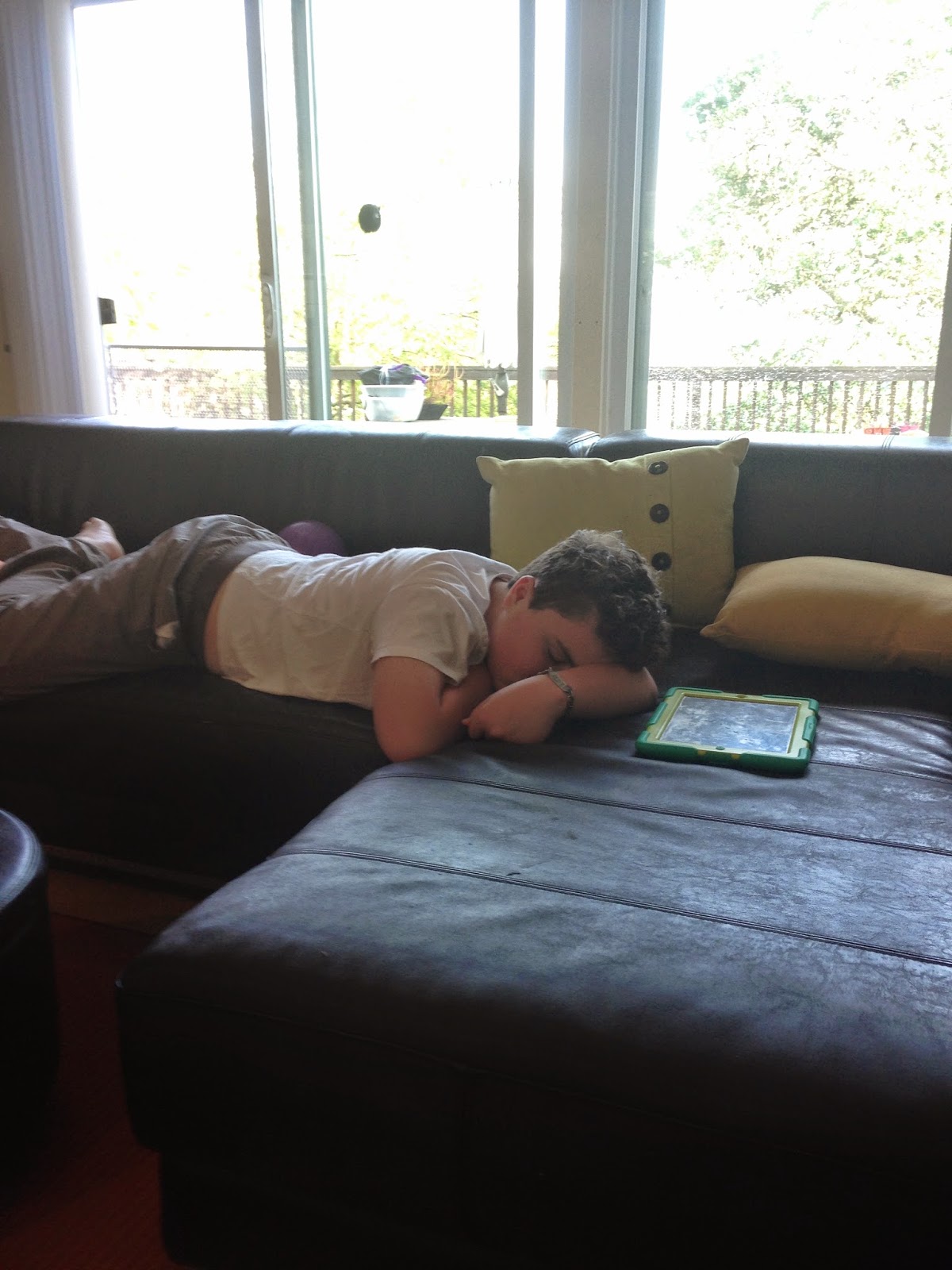
Teens. They can nap. Who knew?
[image: teen with short curly brown hair
and beige skin sleeping face-down
on a brown leather couch, in front of a
bank of windows filled with daylight.]
Leo has a mustache. It's not shave-worthy, not yet -- but it's a mustache all the same. Which means my newly-deep-voiced son is officially a teen, and my lingering denial about him exiting boyhood needs to evaporate. Which means I really have to get serious about planning for his future as a teen, and also as an adult. Not just his personal life, but his school and post-school futures. It's daunting, and I'm anxious.

Thankfully, I'm lucky, we're lucky, Leo is lucky in so many ways. Leo goes to a great school, filled with supportive and understanding staff. The people at Leo's current school district make it possible for him to be at his wonderful school even though it's 20 miles outside the boundaries of that district. I know where to find online tools to help make sense of complicated special education and disability services and planning issues. And, if, heaven forfend, I needed a special education advocate, I know one of the best.

But I'm still nervous, because there are still unknowns and scary processes ahead. So bear with me as I go over the resources and approaches that have made it possible for Leo to be in such a good position now, and will hopefully make his future a bright one. Any additional advice is welcome.

----

Leo just had his triennial IEP,  or his every-three-years full evaluation to adjust his official disability categories, if needed. Even though the process was a straightforward and friendly one, the entire team worked closely to ensure Leo's IEP documentation and goals were crystal-clear. While we might all know what his goals are, and how they should be approached, what if we moved to a new school district? The IEP would move with us, and the new district would need to be able to make sense of Leo's goals. Knowing how to create a useful IEP is a critical skill for parents in my position, so if I did need IEP support, or if I anticipated problems, I'd make the most of online resources like Wrightslaw, or the IEP Wizard from the NEA (National Education Association) Teacher Toolkit.

We were also careful about the goals themselves, about ensuring that they are meaningful (here are some guidelines for writing good goals). For example: I'm interested in Leo getting to learn vocational skills, but I don't want sorting beads to be an IEP goal because our dude would get bored, and fast. I think Leo would like to work on typing specific words, but words that are useful to him, words that are part of his curriculum and life, and not random spelling list words. And so on.

As for his actual placement: He's going to stay in the same classroom, with the same amazing teacher and staff. I firmly believe an inclusive educational environment would be ideal for Leo, but that option is not currently available in our area. (To be clear: By 'inclusion' I mean an educational environment where Leo would be part of classes in which he could participate, given the proper support, on a regular school campus. I do not mean forcible mainstreaming with no supports.) If inclusion was available, I'd be looking to the site Think Inclusive for advice and strategies to ensure Leo was included properly and not just superficially, or (eep) problematically. Though his school does do reverse inclusion, and I have been assured by Leo's teacher that it is a peer-to-peer rather than an "assigned friends" scenario. I would not be pleased if my son was being treated as a project rather than a person.

We also confirmed that Leo will be (finally) getting a symbol-to-speech AAC (augmentative and alternative communication) device in the next few weeks, to supplement his limited spoken language. His SLP and the schools' AAC specialist were careful to emphasize that Leo will be essentially learning a new language, and that it would be easier for him if we could provide an immersive environment, i.e., if we used AAC with him as well. As our insurance will not cover two devices, I've downloaded a complementary iPad AAC app, and will be learning to use it. I am certain I'll be making much use of the strategies and advice at the excellent site PrAACtical AAC.

Another issue was his transition to high school. He will be in ninth grade next year, and that means the elementary school district will stop funding  his education and services, and the high school district will take over. There was no guarantee that Leo would stay at his current school, but thankfully the high school district realized that Leo was in a good place and they could not provide an equally beneficial and enriching environment themselves. However, if there had been problems I would have been frantically consulting the IEP tools and resources at WrightsLaw. And possibly calling my friend, professional special education advocate Carol Greenburg.

Leo will get to stay at his school until the age of 22. But then he needs to have a job, or at least some  place to spend his days so he's not stuck at home with his boring mother. While the NEA provides plenty of practical advice and strategies for becoming a self-advocate, cultivating useful job skills, and supporting young adults through their transition out of school, the actual real-world local opportunities for Leo and people like him are frustratingly elusive, and (again) any advice would be appreciated. (My denial in this area also need to come to an abrupt end. I know, I know.)

And finally, Leo also needs a plan for a future without me, and without his dad. There's no reason, currently, to believe Leo won't outlive us, so it's on us to make sure Leo will have all his needs taken care of, and will also have trustworthy people in his life to help him make the right decisions -- or the right decisions for him, if need be. We have investigated our options and taken the necessary steps to establish resources for our beloved son, and I hope you have explored the options for your family as well -- especially since the recent passage of the ABLE Act, which will allow people with disabilities to save money more easily and with fewer penalties than are currently possible, will hopefully make that planning much easier.

----

How have your recent IEPs, transition meetings, post-school experiences, and future planning gone so far? Feel free to share your experiences in the comments.

----

Disclosure: this post was sponsored by NEA, the National Education Association, which provides extensive online special education resources.

3.26.2015

Never Let Things Go: The Much-Beloved Collapsible Tunnel

Image: Long neon green collapsible tunnel
lying on an orange carpet
with two beigey feetses sticking out.
Our entire house is in disarray at the moment. For hole in the bucket/If You Give a Mouse a Cookie reasons: For her 16th birthday, we moved Iz into what used to be my office. Finding a place for all the stuff that used to be in my office means revisiting nearly every room in the house. Which meant some of those rooms, after years of paints and glitter glue splattering on walls and play doh being ground into carpets, got recarpeted and repainted. Which meant many more things got moved around. And we discovered many things that really weren't being used any more. Which meant that many many many many of those things got purged.

One of the to-purge items was Leo's (we thought) formerly beloved green collapsible tunnel. Which I placed in my "deal with this please" spot by the front door until I could figure out where or to whom it should go.

And then Leo found the tunnel.

And Leo was very very happy to have found the tunnel.

Image: Teen boy with beige skin and
short curly hair standing up inside
a neon green collapsible tunnel
with only his head sticking out
And Leo immediately crawled into it and spend a nice long time just being by himself in the tunnel. Even though, at fourteen, he barely fits. No matter. Yay tunnel.

He also enjoyed getting into the tunnel and walking around in it.

Later on Leo's sister Mali found the tunnel. And she enjoyed doing exactly the same things Leo enjoyed doing.

And everyone was happy. Including me, because that tunnel is one less item to find a new home for.

(Though we still have OMG so much stuff to purge. Any purging/potlatching/eBaying/too much stuff-ing/kids grew out of all this shit so what do we do with it now expert commentary appreciated.)

3.02.2015

Gratitude for Kindred Autistic Spirits

Yesterday Leo and I went to the Bay Area Day of Mourning for people with disabilities killed by parents and caregivers. We came at the end, because sitting through vigils is not easy, and I figured it was better for us to bear witness in the manner that works best for Leo.

And I am going to tell you a little thing that happened there, a small gesture that happened to us among the palpable grief and solidarity that filled the vigil space.

Leo was doing his best to be quiet as Alillia Johnson sang Amazing Grace more beautifully than I thought possible. He tried to be quiet. But he needed to stim and thump, and he wasn't loud, but he wasn't quiet either.

The woman in front of us turned back to look at Leo a few times. I started to panic -- people with disabilities often have sensory sensitivities, and I didn't want her or anyone to be bothered by Leo's stimming. I readied myself to leave before she or anyone else could say anything. But before I could go, she turned around one last time.

And she handed Leo a stim ball. With a smile.

Of course I immediately started crying, with gratitude and relief. Because as much as Leo and I do to be Citizen Advocates and be out and about in public and show the world that being autistic is not a crime, I am always on my guard during those situations. Because while people try to be understanding and usually don't say anything, they might. They might. At any time. Even though we take care to leave if we think we might really disturb others.

We didn't have to worry about that there. We didn't have to worry about that with that kind, generous, accepting woman. We were among Leo's community. We were with the people who would never think of him as less-than, or his life as less worthy, or his stimming as a nuisance rather than a need, and who would raise hell if anyone else treated him badly. He was home, he was with his people.

We then went out for coffee and chocolate with two autistic friends. And everything about that excursion was comfortable. They talked with Leo without talking down to him, included him in the conversations, and one told Leo she was autistic too and he said "Cool." And I did not get the sour, crampy stomach I sometimes get after extended socializing and long outings, because there was nothing stressful about this socializing or those outings. Leo was with his people, with his mother as his very grateful Plus One.

Sometimes it's just easier and more soul-affirming to be with one's people. Whether mourning, stimming, or eating chocolate. Kindred spirits matter. More than I had truly realized, it seems.