
 |
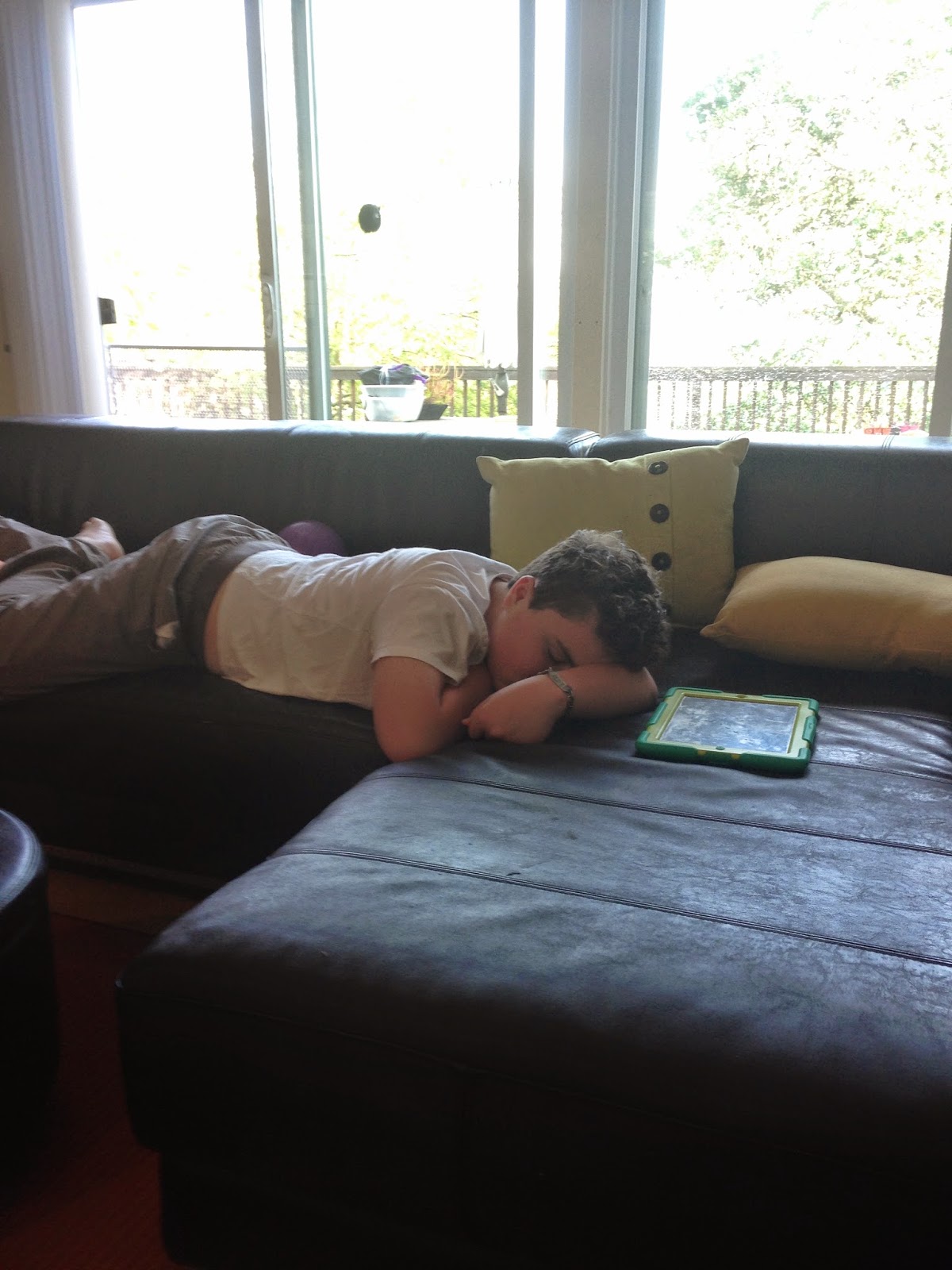
| Teens. They can nap. Who knew? [image: teen with short curly brown hair and beige skin sleeping face-down on a brown leather couch, in front of a bank of windows filled with daylight.] |
Thankfully, I'm lucky, we're lucky, Leo is lucky in so many ways. Leo goes to a great school, filled with supportive and understanding staff. The people at Leo's current school district make it possible for him to be at his wonderful school even though it's 20 miles outside the boundaries of that district. I know where to find online tools to help make sense of complicated special education and disability services and planning issues. And, if, heaven forfend, I needed a special education advocate, I know one of the best.
But I'm still nervous, because there are still unknowns and scary processes ahead. So bear with me as I go over the resources and approaches that have made it possible for Leo to be in such a good position now, and will hopefully make his future a bright one. Any additional advice is welcome.
----
Leo just had his triennial IEP, or his every-three-years full evaluation to adjust his official disability categories, if needed. Even though the process was a straightforward and friendly one, the entire team worked closely to ensure Leo's IEP documentation and goals were crystal-clear. While we might all know what his goals are, and how they should be approached, what if we moved to a new school district? The IEP would move with us, and the new district would need to be able to make sense of Leo's goals. Knowing how to create a useful IEP is a critical skill for parents in my position, so if I did need IEP support, or if I anticipated problems, I'd make the most of online resources like Wrightslaw, or the IEP Wizard from the NEA (National Education Association) Teacher Toolkit.
We were also careful about the goals themselves, about ensuring that they are meaningful (here are some guidelines for writing good goals). For example: I'm interested in Leo getting to learn vocational skills, but I don't want sorting beads to be an IEP goal because our dude would get bored, and fast. I think Leo would like to work on typing specific words, but words that are useful to him, words that are part of his curriculum and life, and not random spelling list words. And so on.
As for his actual placement: He's going to stay in the same classroom, with the same amazing teacher and staff. I firmly believe an inclusive educational environment would be ideal for Leo, but that option is not currently available in our area. (To be clear: By 'inclusion' I mean an educational environment where Leo would be part of classes in which he could participate, given the proper support, on a regular school campus. I do not mean forcible mainstreaming with no supports.) If inclusion was available, I'd be looking to the site Think Inclusive for advice and strategies to ensure Leo was included properly and not just superficially, or (eep) problematically. Though his school does do reverse inclusion, and I have been assured by Leo's teacher that it is a peer-to-peer rather than an "assigned friends" scenario. I would not be pleased if my son was being treated as a project rather than a person.
We also confirmed that Leo will be (finally) getting a symbol-to-speech AAC (augmentative and alternative communication) device in the next few weeks, to supplement his limited spoken language. His SLP and the schools' AAC specialist were careful to emphasize that Leo will be essentially learning a new language, and that it would be easier for him if we could provide an immersive environment, i.e., if we used AAC with him as well. As our insurance will not cover two devices, I've downloaded a complementary iPad AAC app, and will be learning to use it. I am certain I'll be making much use of the strategies and advice at the excellent site PrAACtical AAC.
Another issue was his transition to high school. He will be in ninth grade next year, and that means the elementary school district will stop funding his education and services, and the high school district will take over. There was no guarantee that Leo would stay at his current school, but thankfully the high school district realized that Leo was in a good place and they could not provide an equally beneficial and enriching environment themselves. However, if there had been problems I would have been frantically consulting the IEP tools and resources at WrightsLaw. And possibly calling my friend, professional special education advocate Carol Greenburg.
Leo will get to stay at his school until the age of 22. But then he needs to have a job, or at least some place to spend his days so he's not stuck at home with his boring mother. While the NEA provides plenty of practical advice and strategies for becoming a self-advocate, cultivating useful job skills, and supporting young adults through their transition out of school, the actual real-world local opportunities for Leo and people like him are frustratingly elusive, and (again) any advice would be appreciated. (My denial in this area also need to come to an abrupt end. I know, I know.)
And finally, Leo also needs a plan for a future without me, and without his dad. There's no reason, currently, to believe Leo won't outlive us, so it's on us to make sure Leo will have all his needs taken care of, and will also have trustworthy people in his life to help him make the right decisions -- or the right decisions for him, if need be. We have investigated our options and taken the necessary steps to establish resources for our beloved son, and I hope you have explored the options for your family as well -- especially since the recent passage of the ABLE Act, which will allow people with disabilities to save money more easily and with fewer penalties than are currently possible, will hopefully make that planning much easier.
----
How have your recent IEPs, transition meetings, post-school experiences, and future planning gone so far? Feel free to share your experiences in the comments.
----
Disclosure: this post was sponsored by NEA, the National Education Association, which provides extensive online special education resources.
